What Is the Second Step of Conducting Interviews According to Lecture?

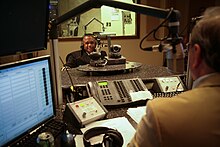
A musician interviewed in a radio studio
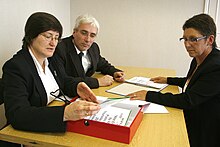
A woman interviewing for a chore

Athletes interviewed after a race

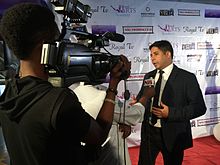
Some interviews are recorded for idiot box circulate
An interview is a structured conversation where ane participant asks questions, and the other provides answers.[1] In common parlance, the discussion "interview" refers to a one-on-one conversation between an interviewer and an interviewee. The interviewer asks questions to which the interviewee responds, usually providing information. That information may be used or provided to other audiences immediately or afterwards. This feature is mutual to many types of interviews – a job interview or interview with a witness to an event may accept no other audience present at the fourth dimension, but the answers will be after provided to others in the employment or investigative process. An interview may also transfer data in both directions.
Interviews usually take place face-to-face and in person but the parties may instead be separated geographically, as in videoconferencing[two] or telephone interviews. Interviews almost always involve spoken conversation betwixt two or more parties. In some instances a "chat" can happen between two persons who blazon their questions and answers.
Interviews tin be unstructured, free-wheeling and open up-ended conversations without predetermined programme or prearranged questions.[3] Ane form of unstructured interview is a focused interview in which the interviewer consciously and consistently guides the conversation and then that the interviewee'south responses do not stray from the main inquiry topic or idea.[4] Interviews tin can also be highly structured conversations in which specific questions occur in a specified order.[5] They tin can follow various formats; for case, in a ladder interview, a respondent's answers typically guide subsequent interviews, with the object being to explore a respondent'southward subconscious motives.[half-dozen] [7] Typically the interviewer has some way of recording the information that is gleaned from the interviewee, often past keeping notes with a pencil and paper, or with a video or sound recorder. Interviews usually take a limited elapsing, with a kickoff and an ending.
The traditional two-person interview format, sometimes called a ane-on-i interview, permits straight questions and follow-ups, which enables an interviewer to better judge the accuracy and relevance of responses. It is a flexible arrangement in the sense that subsequent questions can be tailored to analyze earlier answers. Further, it eliminates possible distortion due to other parties being present.
Face up to confront interviewing helps both parties to interact and class a connectedness, and empathise the other.[8] Further, confront to face interview sessions tin can be more enjoyable.[8]
Contexts [edit]
Interviews can happen in a broad variety of contexts:
Employment. A chore interview is a formal consultation for evaluating the qualifications of the interviewee for a specific position.[nine] [10] One type of job interview is a case interview in which the applicant is presented with a question or task or challenge, and asked to resolve the situation.[11] Candidates may be treated to a mock interview as a training exercise to prepare the respondent to handle questions in the subsequent 'real' interview. A serial of interviews may exist arranged, with the first interview sometimes being a short screening interview, followed by more than in-depth interviews, commonly by company personnel who can ultimately rent the applicant. Technology has enabled new possibilities for interviewing; for example, video telephony has enabled inteviewing applicants from afar.
Psychology. Psychologists use a diverseness of interviewing methods and techniques to try to sympathize and help their patients. In a psychiatric interview, a psychiatrist or psychologist or nurse asks a battery of questions to consummate what is called a psychiatric assessment. Sometimes two people are interviewed by an interviewer, with ane format existence called couple interviews.[12] Criminologists and detectives sometimes use cognitive interviews on eyewitnesses and victims to try to ascertain what can be recalled specifically from a offense scene, hopefully before the specific memories begin to fade in the mind.[13] [14]
Marketing and Academic. In marketing research and academic enquiry, interviews are used in a wide variety of ways equally a method to do extensive personality tests. Interviews are the nearly used form of data drove in qualitative inquiry.[4] Interviews are used in marketing inquiry as a tool that a business firm may utilize to gain an understanding of how consumers call back. Consumer research firms sometimes employ computer-assisted telephone interviewing to randomly dial phone numbers to conduct highly structured telephone interviews, with scripted questions and responses entered directly into the computer.[15]
Journalism and other media. Typically, reporters covering a story in journalism acquit interviews over the phone and in person to proceeds information for subsequent publication. Reporters also interview government officials and political candidates for broadcast.[xvi] In a talk evidence, a radio or idiot box "host" interviews ane or more people, with the topic ordinarily called past the host, sometimes for the purposes of amusement, sometimes for informational purposes. Such interviews are ofttimes recorded.
Other situations. Sometimes college representatives or alumni conduct college interviews with prospective students as a way of assessing a student's suitability while offering the student a chance to learn more about a higher.[17] Some services specialize in coaching people for interviews.[17] Embassy officials may comport interviews with applicants for student visas earlier blessing their visa applications. Interviewing in legal contexts is often called interrogation. Debriefing is some other kind of interview.
Blind interview [edit]
In a blind interview the identity of the interviewee is concealed so as to reduce interviewer bias. Blind interviews are sometimes used in the software industry and are standard in orchestral auditions. Blind interviews take been shown in some cases to increase the hiring of minorities and women.[18]
Interviewer bias [edit]
The human relationship between the interviewer and interviewee in enquiry settings can accept both positive and negative consequences.[nineteen] Their human relationship can bring deeper understanding of the information being collected, however this creates a chance that the interviewer will be unable to be unbiased in their collection and estimation of information.[19] Bias can be created from the interviewers perception of the interviewee, or from the interviewee's perception of the interviewer.[xix] Additionally, a researcher can bring biases to the table based on the researcher's mental state, their preparedness for conducting the enquiry, and the researcher conducting inappropriate interviews.[20] Interviewers tin can use various practices known in qualitative enquiry to mitigate interviewer bias. These practices include subjectivity, objectivity, and reflexivity. Each of these practices allows the interviewer, or researcher, the opportunity to utilise their bias to enhance their work past gaining a deeper agreement of the trouble they are studying.[21]
Run across also [edit]
- Repertory grid interview
- In research
- Telephone interview
- Calculator assisted telephone interviewing
- Interview (research)
- Knowledge transfer
- Online interview
- Mall intercept interview
- Qualitative research interview
- Structured interview
- Unstructured interview
- In journalism and media
- Interview (journalism)
- Talk show
- In other contexts
- Higher interview
- Reference interview, betwixt a librarian and a library user
References [edit]
- ^ Merriam Webster Dictionary, Interview, Dictionary definition, Retrieved February 16, 2016
- ^ "Introduction to Interviewing". Brandeis University. Retrieved 2015-05-02 .
- ^ Rogers, Carl R. (1945). Frontier Thinking in Guidance. University of California: Scientific discipline enquiry associates. pp. 105–112. Retrieved March 18, 2015.
- ^ a b Jamshed, Shazia (September 2014). "Qualitative inquiry method-interviewing and observation". Journal of Basic and Clinical Pharmacy. 5 (4): 87–88. doi:x.4103/0976-0105.141942. ISSN 0976-0105. PMC4194943. PMID 25316987.
- ^ Kvale & Brinkman. 2008. InterViews, second Edition. Chiliad Oaks: SAGE. ISBN 978-0-7619-2542-2
- ^ 2009, Uxmatters, Laddering: A research interview technique for uncovering core values
- ^ "15 Tips on How to Blast a Face-to-Confront Interview". blog.pluralsight.com . Retrieved 2015-11-05 .
- ^ a b Snap Surveys, Advantages and disadvantages of confront to face data collection, Retrieved April 27, 2018
- ^ Dipboye, R. L., Macan, T., & Shahani-Denning, C. (2012). The selection interview from the interviewer and bidder perspectives: Can't take 1 without the other. In N. Schmitt (Ed.), The Oxford handbook of personnel assessment and selection (pp. 323–352). New York Metropolis: Oxford Academy.
- ^ "The Value or Importance of a Job Interview". Houston Chronicle. Retrieved 2014-01-17 .
- ^ Maggie Lu, The Harvard Business School Guide to Careers in Management Consulting, 2002, page 21, ISBN 978-1-57851-581-3
- ^ Polak, L; Green, J (2015). "Using Articulation Interviews to Add Analytic Value". Qualitative Health Inquiry. 26 (12): 1638–48. doi:10.1177/1049732315580103. PMID 25850721. S2CID 4442342.
- ^ Memon, A., Cronin, O., Eaves, R., Bull, R. (1995). An empirical test of mnemonic components of the cognitive interview. In G. Davies, S. Lloyd-Bostock, M. McMurran, C. Wilson (Eds.), Psychology, Law, and Criminal Justice (pp. 135–145). Berlin: Walter de Gruyer.
- ^ Rand Corporation. (1975) The criminal investigation process (Vol. 1–3). Rand Corporation Technical Report R-1776-DOJ, R-1777-DOJ, Santa Monica, CA
- ^ "BLS Information". Glossary. U.South. Bureau of Labor Statistics Partitioning of Data Services. February 28, 2008. Retrieved 2009-05-05 .
- ^ Beaman, Jim (2011-04-14). Interviewing for Radio. Routledge. ISBN978-1-136-85007-3.
- ^ a b Sanjay Salomon (January 30, 2015). "Tin a Failure Resume Aid You Succeed?". Boston Globe. Retrieved January 31, 2016.
- ^ Miller, Claire Cain (25 February 2016). "Is Bullheaded Hiring the Best Hiring?". The New York Times.
- ^ a b c Watson, Lucas (2018). Qualitative research design : an interactive approach. New Orleans. ISBN978-1-68469-560-seven. OCLC 1124999541.
- ^ Chenail, Ronald (2011-01-01). "Interviewing the Investigator: Strategies for Addressing Instrumentation and Researcher Bias Concerns in Qualitative Inquiry". The Qualitative Study. 16 (1): 255–262. ISSN 1052-0147.
- ^ Roulston, Kathryn; Shelton, Stephanie Anne (2015-02-17). "Reconceptualizing Bias in Teaching Qualitative Research Methods". Qualitative Inquiry. 21 (iv): 332–342. doi:10.1177/1077800414563803. ISSN 1077-8004. S2CID 143839439.
greenwoodfloo1970.blogspot.com
Source: https://en.wikipedia.org/wiki/Interview
0 Response to "What Is the Second Step of Conducting Interviews According to Lecture?"
Post a Comment